
How to screen companies in China?

If you read this blog, you are most likely doing business with China or planning to do so. Consequently, there is a good chance that you are dealing with one or more Chinese business partners, or will do so in the future. This Chinese company could be your supplier, distributor, agent, joint venture partner, research partner, licensee, franchisee, service provider or any other type of business partner. What if you are considering to set up a cooperation with this Chinese partner, but you want to ensure it is a legitimate and trustworthy company? In this article we will highlight a few suggestions on how to screen a Chinese company.
Prevention is better than cure
When doing business in China, it is crucial to remain vigilant and avoid potential scams. Scams are common, and a lack of transparency with Chinese partners can sometimes make it difficult to detect red flags early. Cultural differences may also create misunderstandings, which scammers can exploit. Although most Chinese companies are legitimate and serious, it is wise to always remain cautious and expect the possibility of being cheated. By staying alert to these risks, businesses can better protect themselves and make informed decisions when dealing with partners in China.

There are many ways to screen your Chinese business partner, most of which are freely available. For some of them you will need to ask help from a consultant, a Chinese friend or a government agency, as the information is usually only available in the Chinese language. But with a little bit of effort, it is not so difficult to do a quick background check of your Chinese business partner.
Verify Registration
All legal companies in China must be registered with the State Administration for Industry and Commerce (SAIC). You should request a copy of the company’s business license or the company’s registration number and verify it through a third-party or Chinese government websites, such as the National Enterprise Credit Information Publicity System (http://www.gsxt.gov.cn/index.html) or Tianyancha (https://www.tianyancha.com/; only accessible from China).
In any case, make sure you get the company name in the original Chinese characters. Chinese is the only official language in China, names in English or in pinyin (the official system to write Chinese characters in our western alphabet) are usually not sufficient to verify the existence of a Chinese company.
The following information can be found on the websites mentioned above: company name, type and status, registered address, establishment date, term of operation, business license number, business scope, registered capital, paid-up capital, shareholders, officers (legal representative, board of directors, supervisor, general manager), trademarks, patents, possible mortgages, punishments and illegal actions.
Company chops
Each Chinese company has an official company chop or company seal, which serves as a critical form of authentication, and is often considered more important than a signature. The chop is typically round-shaped and features the company’s name in red ink, written in Chinese characters, and sometimes also in English. The Chinese name should correspond with the name on the company’s business license. Knowing what the correct chop looks like is essential, as the official company chop is required for legally binding agreements. Verifying this chop can help prevent fraud and ensure the authenticity of documents.
Mainland China company seal:

Hong Kong seals:

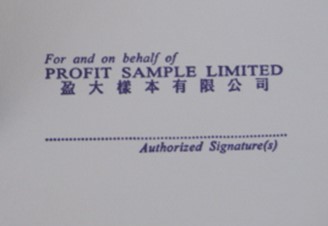
Just ask!
Don’t hesitate to ask questions. You would be surprised to discover that Chinese companies can be quite open and transparent if they are eager to work with you. If they don’t want to share important information with you, that is usually a sign that there is something wrong or they are not really interested in working with you. Here are a few actions and practical suggestions which you could easily carry out yourself:
- Call the general fixed phone line to verify that the company really exists.
- Check the legal address or – if possible – visit the company yourself or ask someone you trust to pay a visit.
- Check if your contacts are working there or are authorized representatives of the Chinese company.
- Talk to third parties: customers, suppliers, competitors, governments, trade associations, media.
- Ask for foreign references and other information.
- Check the official company chop, business license and other company documents (tax certificates, IP registrations, lease agreement/land-use right certificate, financial documents).
- Is the bank account registered under the name of the partner.
Research Online
Another way to find information about your Chinese business partner are online sources. Obviously, using Google as a search engine will probably not bring you far. The most popular Chinese search engine is Baidu, but you may also check other online tools such as Alibaba’s Gold Supplier status, or platforms like Global Sources, which often have verification processes in place. A lot of information usually can also be found through the WeChat search application or other social media. Same as for the official company information mentioned above, you may ask a consultant or a Chinese friend to help you, as most information is only available in the Chinese language.
Signs of suspicion
Below we have listed a few typical signs of suspicion. Although some of these individual items may not be a cause for concern, a combination of multiple of these factors may be worrying and be an indication for a possible scam.
Signs of suspicion are:
- It’s all too good to be true.
- Website is only in English.
- Pushing you all the time – Chinese suppliers love to play on the patience of Westerners.
- No verifiable track-record.
- No company e-mail address.
- Contact person only using an English name.
- Information does not add up – your gut is telling you something is not right.
- No production facilities / no license / no staff.
- Considerably cheaper than market average price.
- Your contact does not work for the company.
- Communication style or contact person is changing.
- They are requesting for facilitation fees or full upfront payment.
In short: when selecting your Chinese business partner, use common sense. Usually that will bring you far and avoid future problems.
If you want to learn more about this or need any advice, please contact us.

Interested in our services?
We are always available to answer any questions you may have. Or interested in a one-hour free consultation?
Contact us